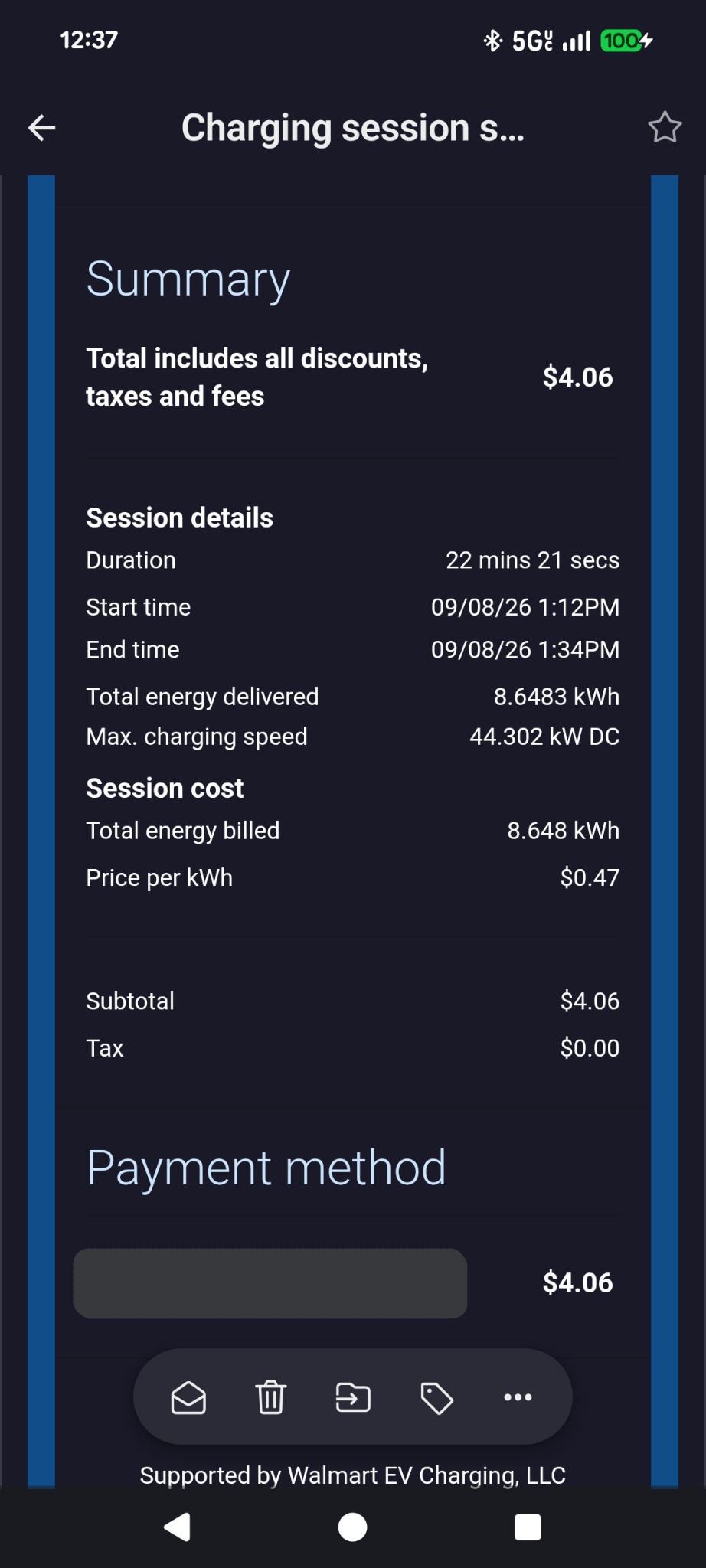
In Chicago area for anyone wondering using the Walmart charging network. This is about ~13% capacity, wasn’t really low started charging at about 70%.
You must log in or register to comment.
- 4 hours
Everyone saying this is expensive, meanwhile I pay 0.60 - 0.80 €/kWh in Germany .-.
- 3 days
$.47 per kilowatt hour? That seems very high to me. How does that compare to the household utility rate?
- Jesusaurus@lemmy.worldEnglish3 days
ComEd is about $0.20 per kwh if you include all the fees, so likely an included surcharge applied.
- 3 days
DCFC is much more expensive than home rates. Approaching petrol cost per km. I don’t use them, but I think that would be an aggressively low rate around here.
The worst ones are the ones that bill by time, so if you have a slow car, it costs more.
- halcyoncmdr@piefed.socialEnglish3 days
The worst ones are the ones that bill by time, so if you have a slow car, it costs more.
Chargers based on time are usually due to laws about only power companies being able to charge for electricity usage.
- nilloc@discuss.tchncs.deEnglish1 day
Wait, why should an electric company be the only one allowed to sell electricity?
If I’m paying for it from them it’s mine. Can I put it in cellphone chargers and rent them out?
Why can’t I sell car charging to my buddy that comes and parks in my driveway and insists on paying for the pixies he uses?
 1 day
1 dayI don’t know but would guess the official answer is something like:
secondary market arbitrage potential exacerbates existing problems such as power theft / meter fraud, bootleg electrical work, unregistered grid ties, etc.
But tbh my very first thought was landlord abuse
Edit: and FWIW what you’re describing sounds more like a service, like offering facilities for rent, than an illegal secondary energy market
- nilloc@discuss.tchncs.deEnglish11 hours
I wonder if this applies to something like an off grid solar car charging setup.
I know the panel and weather requirements are hard to work around, maybe once salt or solid state batteries bring storage costs down we could have modular containers that could be dropped all through the desert or at gas stations and parking lots.
Off-grid part surely bumps the question into fruit stand territory (not a lawyer)
But decentralized energy storage is a foregone conclusion once you accept that the most abundant source of energy isn’t diurnal
Theres a l2 on city property that bills by time here. It comes out to be cheaper than charging at home. I think the city or something asked them to keep the rates low. The city ones were free for a long time too.
not OP but for me it depends, -9c (US6c) here in Australia. I have solar in my roof and 70% of the time i charge there but for every kW of solar I use my provider doesn’t pay me 9c solar feed in fee.
We have timed tariffs in Australia to discourage peak useage, so I get a cheaper overnight tariff 10pm-6AM of 11c (US8c) and use that at times I need a top up over night eg very occasional get home late, leaving early situation. I can schedule charging on the car or on the charger. I have a BYD. For road tripping I have seen 40c-75c but don’t really care as its a very infrequent use.
I’m at 20-22 cents at home and 40-60 using public charging here in philly.
With fast charging you are paying for the service not the power. Most people (that EVs make sense for) will do almost all their charging at home. Fast chargers are for road trips.
I pay 0.1€ at home but fast charger that delivers about 100kW will cost about 0.4€. Chargers that deliver about 300kW cost even more 0.6-0.8€. It’s normal, delivering 150kW costs more than 7kW.
- 2 days
Washington here, I think our residential pricing is $0.13/KWh
- AlphaOmega@lemmy.worldEnglish2 days
My local charger is $0.30 to $0.60 per KWH, charging at home is ~$0.08 for me in the US. Costs me less than $3 for about 100 mile range when I charge from home.
- makeshiftreaper@lemmy.worldEnglish3 days
I agree, that’s a couple cents higher than the superchargers in my area and those are level 3 chargers compared to this level 2. The level 2s in my area are in the .30 to .40 range
- VibeSurgeon@piefed.socialEnglish3 days
The people with charging at home that I know are paying an effective rate close to 0, due to smart electricity contracts where they get time of use rates at a 15 minute resolution. Then they set the car up to charge when the price is basically nothing, typically during night. It’s even possible to get paid to charge when there’s excess capacity in the network.
- 2 days
Our current electricity provider, energy prices can and do dip into the negatives which is great for running AC or heating (don’t believe I’ve seen negatives during winter).
I don’t however own an electric car at this stage, would be nice but the 20k budget models are in my eyes horrible, nor do we have enough spare cash to justify the purchase of anything reasonable.
Man prices are good currently.

- 3 days
That’s what we’re doing with our EV. We have it set to charge during off peak rates which drops down to 0.02 cents/kWh. This equates to a full charge costing us around a dollar.
- 3 days
That’s super cheap. Does that include distribution charges?
Our utility has had a few plans geared at auto, including a second meter that they could remotely disable if necessary, but their current plans are nowhere near as good.
Here’s their best time of use plan if you can push most of your use into the evenings:

There will be a subset of a generation of kids that know elementary/middle/high school physics with regards to energy and electricity far better than their teachers.
- 2 days
I know everything fluctuates, especially with idiots starting wars and different cars getting different efficiencies, but is there a good average comparison of what you pay per mile electric vs gas?
- 2 days
Gas car: cost per mile = price per gallon ÷ miles per gallon
Let’s assume 30 mpg and $4.50 a gallon, that’s $0.15 per mile.
Electric car: cost per mile = price per kWh ÷ miles per kWh
Let’s assume 3.5 miles per kWh and residential rates of $0.14 per kWh, that’s $0.04 per mile.
Fast chargers will push the cost much higher in the US. They can charge $0.60 per kWh or higher at peak hours, which would put you at $0.17 per mile in the same car. There are ways to bring that cost down too if that’s your only way to charge.
Would also note that this charger was 47¢/kwh. That’s $0.134/mile - very close to the gas calc you did
So OP is talking about spending only $4 to top up, but that’s basically the equivalent of buying a gallon of gas at this energy price. Basically you need to charge at home to get the pricing benefits over gas.
Obviously a bunch of other benefits to EVs
With other benefits you mean like no oil changes or longer lasting brake disks and pads?
Yeah and better for GHGs obviously
And depending on use case, can be more convenient than gas - if you only have a basic commute and can charge at home. But gas may still be more convenient for some people (long distance in rural or remote areas for example; apartment living for another)
The only thing I would add to Dogyote’s EV math is a lot of states (like Ohio) charge extra for EV registration ($200 more in Ohio). So if you drive an average of 12,000 miles per year, that extra registration fee account for an additional 1.667 cents per mile. But its still 10 cents cheaper per mile vs gas. Gas would have to cost less than $2 to compete price wise.
- 3 days
In case it helps, that amount of electricity is good for about 30 to 35 miles of driving.
Yes, high speed chargers cost similar to gas (normal gas, not the current prices). Slow chargers cost about half of that. Charging at home is about half of that again (0.1€/kWh)
Right now a gallon of regular gas in the same area is about $4.75. My ICE car gets about 35mpg on average (although I do have to run premium, not regular). So yeah, less than $1 cheaper to operate for the same distance. At least off of the highway. On the highway, the ICE car still wins because electric cars dont see efficiency gains the same way during different methods of use unless they have regenerative braking. So while my ICE gets 35 mpg average, Im easily breaking 60mpg on the highway. But the electric probably does far better in the city stopping constantly since its regenerating every time it brakes. Maybe it evens out, but I think the ICE is still probably overall a bit less expensive when solely looking at cost of energy consumption vs milage. At least assuming that someone is primarily driving on the highway out of traffic rather than in traffic or in the city
Charging prices probably dont fluctuate quite as intensely as gas prices, but ultimately the energy market is the energy market so theyre both going to rise with the tide in the general sense.
The real savings advantage that an electric car has is in the simplicity of the parts and less regular maintenance needs. But that is pretty easily blown out of the water by the initial purchase price. An EV would be 3x what I paid for my ICE, and the lifetime maintenance isnt going to be on the order of $40k+. No matter what you buy youre getting screwed somewhere, you just get to pick the hole.
Unless we start seeing $20k MSRP EVs in the US they really arent more affordable than ICE cars by any means
- 3 days
At $0.47/kw that math adds up. Charging out and about is expensive. They likely pay less then half that if they are able to charge at home.
Based on them being near chicago, they may be able to charge as cheap as $0.09/kw (same rate Technology Connection says he averages). At those rates, EVs get a lot more competitive.
- 3 days
Basically all EVs have regen braking. Which is why EVs are actually a bit more efficient in town than highway: stop and go barely affects them and wind resistance is 4x less than highway at twice the speed. ICE vehicles as you know work the opposite way in terms of efficiency
That is quite expensive.
I would encounter a rate like that charging at >200 kW maybe on an interstate or at our high end mall, but not a Walmart.
Of course, I mostly charge at work for free or home for $0.15/kWh.
- 2 days
is it? 5 bucks, rounded, for 13%? means that’s like 40 bucks for 100%?
my tank of gasoline is like 100 bucks for 100%.
- 2 days
Yes, it is. Obscenely so. Why are you comparing it to a tank of gasoline MPG? It’s not gasoline. Compare it to how much you can buy a KWh from the local utility company. This would be the profit equivalent of a gas station charging you around $15 for a gallon of regular.
EDIT: You know, now that I think about it, they are selling power to the public. Why do they not have to abide by the rates set forth by the PUC (OUC)?
- 2 days
I always assumed the cost of the infrastructure was past of the kilowatt price. I know at my school it cost them about $300k to install a half dozen charge stations. Commercial construction like that is stupidly expensive compared to running a charger at home.
- 2 days
Yeah, I estimated infrastructure in that $15 number to be similar infrastructure cost as a gas station. It turns out infrastructure costs for a gas station are far higher than a charging station so the gouging is even worse than that.
- 2 days
i am not considering mpg just amt to get to full. i dont disagree it’s high but i have no exp with elec vehicles. i’ll take your word for it!
- 2 days
Couple things here but in general the fast chargers are pretty expensive.
- The range on EV is usually smaller than a gas car. So comparing a full tank for you vs a full tank for them might not be a good comparison
- Around where I live the worst fast charger rate ( which is basically all reasonable hours of the day) is 60% to 100% more expensive than either home electricity or level 2 charging rates.
- It seemed to me that fast charging was priced so that it was close to gas prices while home charging was totally disconnected from gas prices. Not sure if this observation has held up now with gas price spikes, I haven’t been fast charging recently so out of the loop
- adhocfungus@midwest.socialEnglish3 days
Good Lord, I thought I got ripped off the one time I had to pay and it was only pay 99 cents. I’m very fortunate there are so many free chargers here.