To the attention of Threads and its affiliated companies:

  • I do not grant you any license to use the content published by this Lemmy personal account.
  • I inform you that, based on the GDPR of the EU, the exercise of the rights recognized therein: being informed, access, notification, and object.
  • 35 posts
  • 0 comments
Joined 3 years ago
Cake day: June 26th, 2023

Colorado Miners Strike (1927)

Tue Oct 18, 1927

Image


On this day in 1927, the Industrial Workers of the World (IWW) called a strike of all mine workers, which was quickly heeded in Colorado. Nearly all the mines in Colorado were closed, and the dozen still open did so using imported scab labor. For the still-operating Columbine mine, scab workers were housed in Serene, which was fortified with barbed wire on the fences and armed guards.

Mass rallies had been held by workers outside the Columbine mine in Serene for several weeks and, on the morning of November 21st, miners and their families were fired upon by a militia of ex-police, armed with machine guns and tear gas. Six people were killed, and the event became known as the “Columbine Massacre”.

The owner of the Rocky Mountain Fuel Company, Josephine Roche, brought an end to the strike several weeks after the incident at Columbine by declaring that the company union was to be affiliated with the American Federation of Labor (AFL) and recognizing the United Mine Workers of America (UMWA). The backbone of IWW support in the Colorado mines was broken, and the revolutionary union went into decline.


Laureano Cerrada Assassinated (1975)

Sat Oct 18, 1975

Image


Laureano Cerrada Santos was an anarchist activist and member of the Confederación Nacional del Trabajo (CNT) who was assassinated on this day in 1975.

Santos fought in the Spanish Civil War, helped found the railway union of the CNT, and ran a large forgery operation in France that helped bankroll anti-fascist activism in Francoist Spain.

On January 18th, 1951, an attempted robbery committed by Spanish anarchists went wrong, killing at least three people and wounding eight innocent bystanders.

The Francoist government used this episode to lead a widespread crackdown on the libertarian movement, and France soon followed suit. Cerrada was exiled from the CNT for his association with these activities, but continued his work after being released from prison.

On this day in 1975, Cerrada was murdered by Ramón Benicho Canuda, a CNT infiltrator and French Mafioso who killed Cerrada to prevent his discovery. Canuda fled to Canada after the murder, and was never charged for the crime. Named as working for a foreign power while in Toronto, Canuda subsequently disappeared.


Pérez Collado (1915 - 2014)

Sun Oct 17, 1915

Image


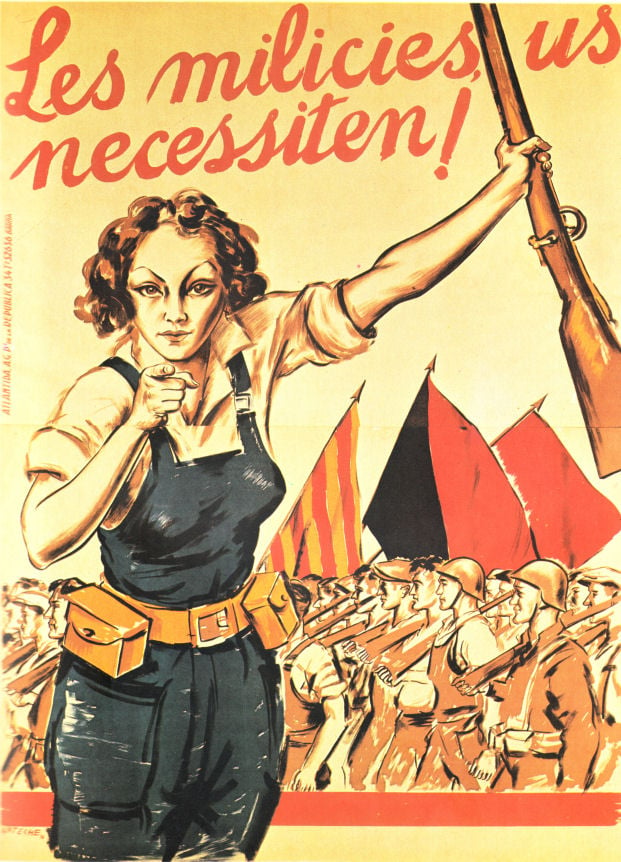
Concha Pérez Collado, born on this day in 1915, was an anarchist involved with the Confederación Nacional del Trabajo (CNT) and anti-fascist soldier during the Spanish Civil War.

When the Civil War broke out, Collado already had access to weapons and training because she was part of an anarchist group that were preparing for what they saw as an inevitable military uprising. She saw action in Barcelona and Aragon, attacking prisons, building barricades for her neighborhood, and working in a munitions factory, before eventually moving to a French refugee camp where she gave birth to her only son.

Pérez Collado returned to Spain under Francisco Franco’s rule and ran a jewelry shop with her partner Maurici Palau which doubled as a secret meeting place for anarchists. From 1982 to 1984, Collado participated in a series of interviews with Nick Rider about anarchism in Spain during the 1930s.


Paris Massacre (1961)

Tue Oct 17, 1961

Image


The Paris Massacre was a brutal instance of police repression against Algerians that occurred on this day in 1961, during the Algerian War.

There were multiple episodes of violence between French police and the French Algerian community during the anti-colonial Algerian War: racist French cops terrorized Algerians, while pro-liberation groups targeted and killed police with bombing campaigns.

It was in this context that the head of the Parisian police, Maurice Papon (a former Nazi collaborator later convicted of crimes against humanity) ordered police to kill Algerians, promising that they would be protected from any consequences.

Under these orders, the French National Police attacked a demonstration by 30,000 pro-National Liberation Front (FLN) Algerians on October 17th, beating dozens to death and throwing people into the Seine river, where many drowned. After 37 years of denial and censorship of the press, the French government finally acknowledged 40 deaths in 1998, although there are estimates of 100 to 300 victims.


Enver Hoxha (1908 - 1985)

Fri Oct 16, 1908

Image

Image: **


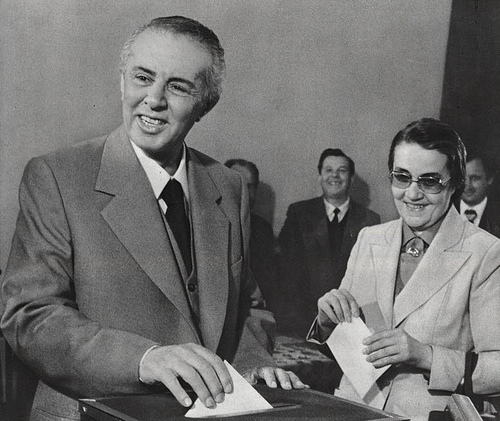
Enver Hoxha, born on this day in 1908, was the communist leader of Albania from 1946 to 1985, leaving behind a complex legacy of feminism and greatly improved access to healthcare and education, coupled with what critics perceive as a paranoid personality cult and brutal state repression.

Hoxha is also known for having sharp ideological and political disagreements with the Soviet Union and communist Yugoslavia, siding most strongly with and receiving aid from Maoist China.

Before coming into power, Hoxha was a French school teacher and librarian, becoming a communist partisan after fascist Italy invaded Albania in 1939. In March 1943, the first National Conference of the Communist Party elected Hoxha formally as First Secretary.

It was in this position as First Secretary that Hoxha became head of state after the Albanian monarchy was abolished in 1946.

In the years after Stalin’s death, Hoxha grew increasingly distressed by the policies of the Soviet leadership and of Khrushchev in particular. China was also disillusioned with Soviet behavior at this time, and Hoxha found common ground with Mao Zedong’s criticisms of Moscow. By 1961, Hoxha’s attacks on the “revisionist” Soviet leadership had so infuriated Khrushchev that he elected first to terminate Moscow’s economic aid to Albania and ultimately to sever diplomatic relations entirely.

Under Hoxha’s leadership, the Albanian literacy rate improved from 5-10% in rural areas to more 90%. Hoxha was also a proponent of women’s rights, stating “the entire party and country should hurl into the fire and break the neck of anyone who dared trample underfoot the sacred edict of the party on the defense of women’s rights”. Accordingly, more than 175 times as many women attended secondary schools in 1978 than had done so in 1938.

Critics of Hoxha point out that his reign had state repression of dissidents reminiscent of the Soviet Union and what they perceived as a paranoid personality cult. The 1992 book “Albania: A Country Study”, commissioned by the U.S. government, alleged that one out of three Albanians had either been interrogated by the Sigurimi secret police or incarcerated in labor camps.

Hoxha died in 1985, leading Ramiz Alia to succeed him as head of state. Although Albania was one of the poorest European nations at the time of his death, the country was also economically self-sufficient, carrying minimal foreign debt and boasting a trade surplus of $10 million.

“Every departure from class struggle has fatal results for the destiny of socialism.”

- Enver Hoxha


Mass Protest Against Prop 187 (1994)

Sun Oct 16, 1994

Image


On this day in 1994, an estimated 70,000 demonstrators marched across Los Angeles in opposition to Prop 187, a ballot initiative that prevented any undocumented immigrant (both children and parents) from accessing public school, public healthcare, and public universities. The demonstration against Prop 187, known as the “Save Our State” initiative, is one of the largest mass protests in Los Angeles’ history.

Although the ballot initiative passed at first, public and legal pressure from opponents of Prop 187 led to a federal court order preventing enforcement of the measure. The law was finally killed in 1997, when it was declared unconstitutional. The political controversy surrounding the law led to widespread voter registration from the Latino population, and is considered a major factor in California’s subsequent shift away from the Republican Party.


Moratorium to End the War in Vietnam (1967)

Sun Oct 15, 1967

Image

Image: **


The Moratorium to End the War in Vietnam was a national series of protests and teach-ins against the Vietnam War that began on this day in 1967. One politician noted it was the first time anti-war protests reached the level of a mass movement.

This protest was followed a month later by a large Moratorium March in Washington, D.C. Socialist politician Fred Halstead wrote that it was “the first time [the anti-war movement] reached the level of a full-fledged mass movement.”

Over a quarter of million people attended the Moratorium march in Washington, D.C., where they marched down Pennsylvania Avenue in the evening bearing candles led by Coretta Scott King to the White House. Scott King told the marchers that it would have delighted her assassinated husband, Martin Luther King Jr., to have seen people of all races rallying together for the cause of peace.

Rallies held in New York, Detroit, Boston (where about 100,000 attended a speech by anti-war Senator George McGovern), and Miami were also well attended.


Thomas Sankara Assassinated (1987)

Thu Oct 15, 1987

Image


Thomas Sankara was a Burkinabé revolutionary who expanded social welfare and nationalized natural resources in Burkina Faso. On this day in 1987, Sankara was assassinated in a coup led by Blaise Compaoré, who succeeded Sankara in power.

Thomas Sankara was a Burkinabé revolutionary and President of Burkina Faso, assassinated on this day in 1987. A Marxist-Leninist and Pan-Africanist, he was viewed by supporters as a charismatic and iconic figure of revolution and is sometimes referred to as “Africa’s Che Guevara”.

Sankara came into power when allies instigated a coup on his behalf in 1983. He immediately launched programs for social, ecological and economic change and renamed the country from the French colonial name Upper Volta to Burkina Faso (“Land of Incorruptible People”), with its people being called Burkinabé (“upright people”).

Sankara’s administration refused foreign aid to remain politically independent, with him stating “Imperialism often occurs in more subtle forms, a loan, food aid, blackmail”. He also began nationalizing land and mineral wealth and promoted literacy, women’s rights, and public health.

On this day in 1987, Sankara was assassinated by troops led by Blaise Compaoré, who assumed leadership of the state shortly after having Sankara killed. A week before his murder, Sankara had declared: “While revolutionaries as individuals can be murdered, you cannot kill ideas”.


Max Hoelz (1889 - 1933)

Mon Oct 14, 1889

Image


Max Hoelz, born on this day in 1889, was a German Communist most known for his role as a “Communist Bandit” in the 1920s, leading raids against police, releasing prisoners, and destroying property deeds.

Hoelz was politically radicalized by the 1917 October Revolution in Russia, and by contact with Georg Schumann, a member of the socialist Spartakusbund (Schumann was later to be executed by the Nazis in 1945).

In 1920, after the right-wing Kapp Putsch, Hoelz organized workers from Falkenstein and Oelsnitz in a Red Guard, leading armed bands against the police, the army, and the far-right paramilitary Freikorps. In this role, he became a kind of “Robin Hood”, raising money from employers under threat of reprisals, liberating prisoners, destroying property deeds and police archives, and burning villas of the rich.

Later in life, after the Nazis began to come into power, he moved to Soviet Russia. There, however, he became a dissident, criticizing bad working conditions in the country. On September 15th, 1933, he died in a “boating accident”, which is speculated by anarchist historian Nick Heath to actually have been an NKVD assassination.


Dorothy Bolden (1923 - 2005)

Sat Oct 13, 1923

Image


Dorothy Lee Bolden, born on this day in 1923, was the founder of the National Domestic Worker’s Union of America and civil rights activist who fought for women’s rights and an end to segregation.

Bolden began working as a domestic worker at the age of nine and would eventually utilize her past experiences to form the Domestic Worker’s Union in Atlanta, Georgia.

The Domestic Worker’s Union had over 13,000 women members throughout the United States and won better pay and working conditions for them. Bolden was also responsible for registering thousands of black Americans to vote.

“I would say to [young people] that you have got to show yourself that you can be independent on your own. You don’t have to follow. Why do we have to follow Tom, Dick and Harry to anything when we have the strength to be ourselves and be what we ought to be. What do you want to be? Ask yourself. Get in the mirror and look at yourself and say, 'So what do I want to be, what do I want to do? Where do I want to go and how do I get there?”

- Dorothy Bolden


Ding Ling (1904 - 1986)

Wed Oct 12, 1904

Image


Ding Ling, born on this day in 1904, was a prominent Chinese Marxist and feminist author. Despite being a member of the Communist Party, she was imprisoned and sentenced to manual labor during the Cultural Revolution.

In her early career, Ding Ling wrote highly successful short stories centering on young, unconventional Chinese women. Around 1930, she became a major literary figure of the leftist literature.

In 1931, her husband, communist poet Hu Yepin, was executed in Shanghai by the right-wing Kuomintang government for his association with the Communists. Shortly thereafter, Ding joined the Chinese Communist Party and her work reflected communist values.

According to authors Glenn Kucha and Jennifer Llewellyn, in 1957 Ding was denounced as a “rightist”, purged from the party, imprisoned, and her fiction and essays were banned.

Ding and her husband were then sent to the countryside and compelled to do manual labor for more than a decade. She was rehabilitated sometime in the years following Mao Zedong’s death in 1976.

“Happiness is to take up the struggle in the midst of the raging storm and not to pluck the lute in the moonlight or recite poetry among the blossoms.”

- Ding Ling


Battle of Virden (1898)

Wed Oct 12, 1898

Image

Image: Miners gathered on the train tracks in Virden, Illinois, the day before the Battle of Virden. October 11th, 1898. From the Mother Jones Museum.


On this day in 1898, the Battle of Virden began when armed members of the United Mine Workers of America (UMW) surrounded a train full of strikebreakers and exchanged fire with company guards. 13 people were killed, dozens more wounded.

After a local chapter of the UMW began striking at a mine in Virden, Illinois, the Chicago-Virden Coal Company hired black strikebreakers from Birmingham, Alabama and shipped them to Virden by train.

The company hired armed detectives or security guards to accompany the strikebreakers, and an armed conflict broke out when armed miners surrounded the train as it arrived in town. A total of four detectives and seven striking mine workers were killed, with five guards, thirty miners, and an unrecorded number of strikebreakers wounded.

After this incident, Illinois Governor John Tanner ordered the National Guard to prevent any more strikebreakers from coming into the state by force. The next month, the Chicago-Virden Coal Company relented and allowed the unionization of its workers.

“When the last call comes for me to take my final rest, will the miners see that I get a resting place in the same clay that shelters the miners who gave up their lives on the hills of Virden, Illinois…They are responsible for Illinois being the best organized labor state in America.”

- Mother Jones


D.C. Jail Uprising (1972)

Wed Oct 11, 1972

Image

Image: Inmates shouting to reporters and others gathered outside the D.C. jail. Source: Washington Area Spark and DC Public Library, Star Collection


On this day in 1972, inmates at a Washington, D.C. jail seized control of part of their prison, taking hostages and demanding to be released.

The uprising began when an inmate pretending to have a seizure drew a loaded .38 pistol on the two officers that came to check on him. After subduing the officers, they freed 50 other inmates and took control of the cellblock, capturing several other guards as hostages in the process.

The inmates demanded to speak to a prison reporter, Washington Claiborne. Inmates issued varying statements to him that indicated a revolutionary fervor among prisoners:

“We don’t want nothin’ but the sidewalk. What do you think we want, better food? Bullshit. We want the sidewalk, man.”

“We want you to understand one thing very clearly. This is not a riot, it’s a revolution.”

“We ain’t bitches, man. We don’t mind dying for the fucking cause.”

Prison negotiators eventually got the inmates to back off of demanding release, but only in exchange for the opportunity to go before a federal judge to air their grievances about the jail and the promise of no reprisals for their actions. The inmates got their hearing, and a new facility was built.

Despite the promise of no reprisals, all nine inmates who participated in the uprising were prosecuted and convicted on various charges.


El Centro de la Raza Founded (1972)

Wed Oct 11, 1972

Image

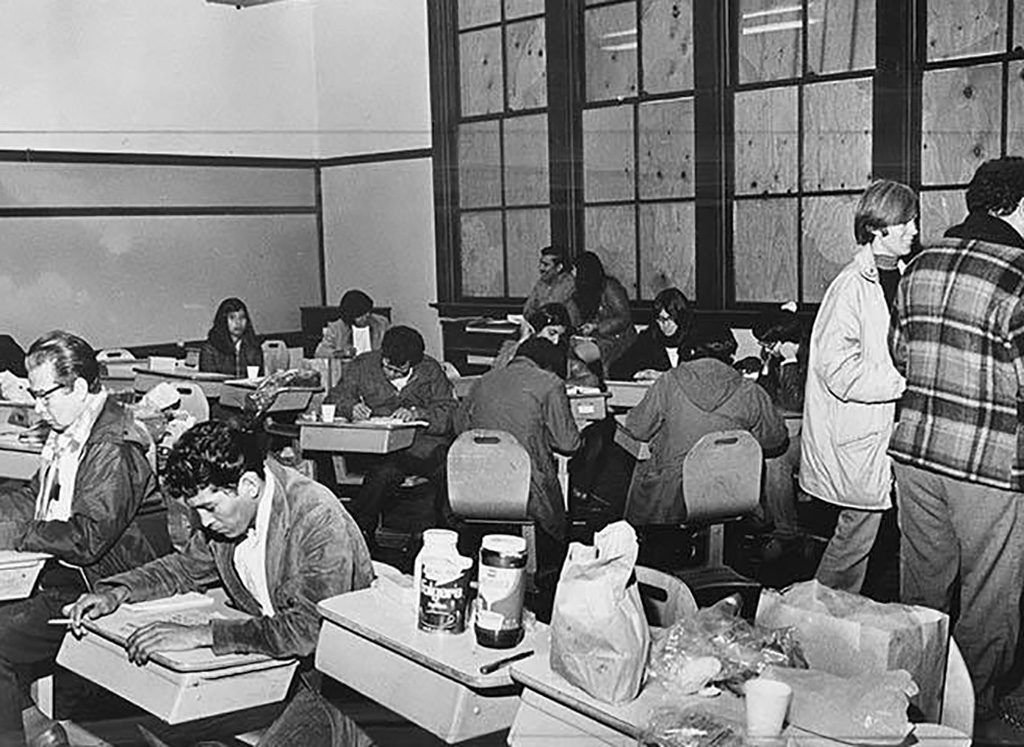
Image: Group in classroom at occupied Beacon Hill School, Seattle, October 11th, 1972. Photo by Phil H. Webber [historylink.org]


On this day in 1972, ESL staff from South Seattle Community College, students, and families occupied a vacant school building in the Beacon Hill neighborhood, founding El Centro de la Raza (“The Center for the People of All Races”).

After three months of occupying the building and numerous rallies, petitions and letters, the Seattle City Council finally agreed to hear the case of the occupiers. Although City Council approved the lease, Mayor Wes Uhlman vetoed the action, causing supporters to occupy the mayor’s office. A five-year lease signed January 20th, 1973, at $1 rent annually.

According to author David Wilma, in 1997 the school district insisted on fair market rates, causing rent for the property to rise to $12,000 a month. By 1999, El Centro owed $150,000 in back rent. Grants from the City of Seattle and from Washington state totaling $1 million finally allowed El Centro to buy the site from the school district.

Today, El Centro de la Raza continues to function as an educational, cultural, and social service agency. It is considered a significant part of civil rights history in the Pacific Northwest.

In 2015, El Centro de la Raza built more than one hundred moderately-priced apartments south of its main building. The apartments are designed for families making 30-60% of the average median annual income in Seattle, or $24,000 to $49,000.


West African Railway Strike (1947)

Fri Oct 10, 1947

Image

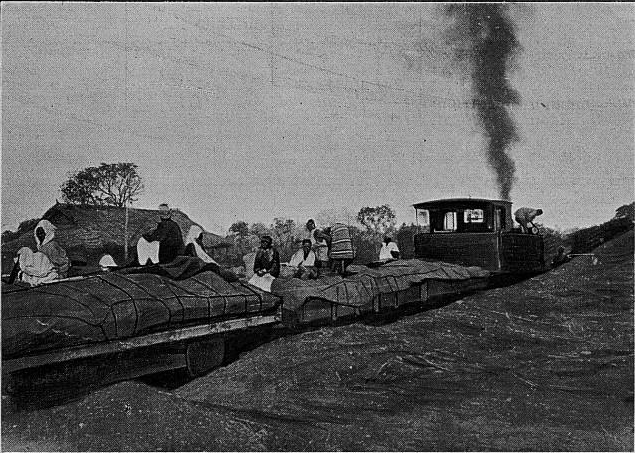
Image: A train traveling along the Dakar–Niger Railway, c. 1908 [Wikipedia]


On this day in 1947, the longest strike in African history at the time began, stretching across all branches of railway in French West Africa, the wharfs in Dahomey, and the Ivory Coast.

For more than six months, 17,000 railway workers and 2,000 workers in the wharfs refused to work. The timing of the strike was crucial, undermining new French economic goals for the railway.

The strike was organized by Ibrahima Sarr, the Federal Secretary of the Railway Union. Workers demanded housing, rights for temporary workers, wages to follow regional differences in the cost of living, and clearer standards for promotions.

The government did not respond for three months, assuming the strike would collapse due to economic pressure. Workers had prepared for this, however, taking up community collections, the community exiling strikebreaking workers, and women of the household economically sustaining families while workers were on strike.

On March 19th, the workers’ union accepted a set of proposals favorable to their demands and returned to work. The strike ended with a long, celebratory march into Thiès, followed by meetings and dancing.


Panama City Tenants’ Revolt (1925)

Sat Oct 10, 1925

Image

Image: American troops patrolling the streets of Panama City during the latter days of the tenant revolt [panamaviejaescuela.com]


On this day in 1925, striking tenants in Panama City held a massive, illegal rally to protest high rent and bad living conditions. Riots began after police killed four demonstrators, prompting a U.S. occupation that lasted until October 23rd.

In the months preceding the uprising, the “Liga de Inquilinos y Subsistencia” (English: Tenants’ Subsistence League) had been organizing against rent increases and poor living conditions. On the last day of September, in response to the government of Panama repressing this organizing, the League announced a rent strike to begin October 1st.

On Saturday, October 10th, 1925, the League organized a massive rally in Panama City to protest increased rents and poor living conditions. This was held in defiance of a state ban on such a gathering.

Panama City Mayor Mario Galindo had permitted the National Police to respond to any large gatherings with violent force. Accordingly, at the October 10th rally, four tenants were shot dead by police following a confrontation at Parque de Santa Ana, and many more were injured.

Riots broke out following this violence. By Sunday, October 11th, the city district of Santa Ana had come almost entirely under the control of the Tenants’ League. With the police ineffectual in stopping the revolt, the government of President Rodolfo Chiari requested the military intervention of the United States.

Within a few days (sources differ on the exact day, ranging from October 12th to October 15th), approximately 600 United States soldiers entered Panama City. Stationing themselves at Parque de Santa Ana and Parque de Lesseps, they conducted raids on the offices and apartments of Tenants’ League leaders, quickly crushing the uprising by arresting its prime organizers.

While the uprising was ongoing, government officials met with tenant and landlord representatives in Panama City. According to the Academy of American Franciscan History, the government promised more public works projects, a shake-up of the national police force, and to establish a rent claims commission that met daily to hear tenant grievances.

The U.S. troops continued to occupy Panama City until October 24th, by which point the protests had subsided. On October 30th, the League and landlords signed an agreement to end the strike.

“With rhythmic heels that oppressed the heart and clouded the eyes, an army of soldiers in battle dress, with helmets of the kind used in the European war, entered with a fixed bayonet, sweaty, their backpacks on their shoulders, and their revolvers on their belts.”

- Revista Lotería, October-November 1973 issue, describing the American military presence


Little Falls Textile Strike (1912)

Wed Oct 09, 1912

Image

Image: Little Falls textile strikers in front of the strike headquarters (Slovak Hall)


On this day in 1912, Phoenix Mill workers in Little Falls, New York spontaneously walked off their job to demand a wage increase and a 54-hour work week. The labor action is known as the Little Falls Strike.

The Industrial Workers of the World (IWW) sent in organizers such as Matilda Rabinowitz, Ben Legere, Joe Ettor, and “Big Bill” Haywood to assist with the strike, resulting in many of the striking workers voting to join the IWW.

The strike ended on January 3rd, 1913 with the striking workers and IWW prevailing. The workers’ demands were met, including the 54-hour work week at the previous 60-hour pay.


Che Guevara Executed (1967)

Mon Oct 09, 1967

Image

Image: **


On this day in 1967, communist revolutionary Che Guevara was executed by CIA-assisted forces in Bolivia, where he had been attempting to foment revolution. His last words were “Shoot, you are only going to kill a man.”

Ernesto “Che” Guevara was an Argentine Marxist revolutionary, physician, author, guerrilla leader, diplomat, and military theorist. A major figure of the Cuban Revolution, his stylized visage has become a ubiquitous countercultural symbol of rebellion and global insignia in popular culture.

After serving in Castro’s government, Guevara left Cuba in 1965 to foment revolution abroad, first unsuccessfully in Congo-Kinshasa and later in Bolivia. While agitating for communist revolution in Bolivia, Guevara was captured by CIA-assisted state forces and summarily executed on this day in 1967.

On November 3rd, 1966, Guevara had secretly arrived in La Paz on a flight from Montevideo under the false name Adolfo Mena González, posing as a middle-aged Uruguayan businessman working for the Organization of American States (OAS). Once there, Guevara had difficulty getting cooperation from both local dissidents and the Bolivian Communist Party, despite besting the Bolivian military in several skirmishes.

To help crush the resistance movement, the Bolivian government and U.S. military relied on the expertise of fugitive Nazi war criminal Klaus Barbie, who had undermined the French Resistance and was responsible for the torture and murder of its leader, Jean Moulin.

Some of the inhabitants willingly informed the Bolivian authorities and military about the guerrillas and their movements in the area, which contributed to Guevara’s capture on October 7th, 1967. He famously shouted “Do not shoot! I am Che Guevara and I am worth more to you alive than dead!”, however he remained defiant in captivity.

On October 9th, on orders from the Bolivian President René Barrientos, Guevara was executed. In the documentary “My Enemy’s Enemy”, German journalist Kai Hermann alleged that Barbie devised the strategy that led to Guevara’s capture.

“The true revolutionary is guided by a great feeling of love. It is impossible to think of a genuine revolutionary lacking this quality.”

- Che Guevara


West Coast Longshore Strike (1923)

Mon Oct 08, 1923

Image


On this day in 1923, the International Longshoremen’s Association (ILA) in Vancouver struck for higher wages. With a force of 350 company guards protecting the dock and scabs, work continued until the strike’s defeat in December.

The Shipping Federation imported strikebreakers, housed in the CPR ship Empress of Japan, while an armed group of 350 men guarded the waterfront from potential interference from striking workers.

The longshoremen gave up on December 10th, and the Shipping Federation took over the dispatch of the work force, formerly controlled by the union, and set up a company union, the “Vancouver and District Waterfront Workers Association”.

This union would go on to lead the more well-known West Coast Longshore Strike of 1935.


Socialist Rifle Association Founded (2018)

Mon Oct 08, 2018

Image


The Socialist Rifle Association (SRA), incorporated in Kansas on this day in 2018, is a firearm organization dedicated to “providing working class people the information they need to be effectively armed for self and community defense”.

The SRA describes the mission of their organization as “to provide an alternate to the mainstream, toxic, right-wing, and non-inclusive gun culture that has dominated the firearms community for decades. We seek to provide a safe, inclusive, and left-leaning platform for talking about gun rights and self defense, free from racist and reactionary prejudices, while providing a platform for the working class to obtain the skills necessary for all aspects of community defense”.