

The organization in the ad, the National Foundation for Infantile Paralysis, was founded by US President Franklin D. Roosevelt in 1938. You may know it by its current name, the March of Dimes. The president’s call to action saw an overwhelming response. The surge in funding helped Jonas Salk develop the first polio vaccine at the University of Pittsburgh. It was front page news all around the world:

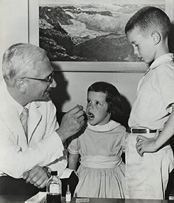
Although it gave successful protection, it would be Albert Sabin’s oral vaccine developed at the University of Cincinnati that would become instrumental in eliminating polio in most countries (there is still natural spread in a few). This is Sabin giving his vaccine to a child in the 1960s. It was often given on sugar cubes.
Massive efforts were held at schools and public venues. This was easier in the days before social media and rapid online spread of disinformation.

The single most famous iron lung ward photo was actually staged for a film, but a typical iron lung ward in the era looked like this.

In the height of the polio pandemic around 1952, the US alone had over 3000 deaths due to respiratory paralysis in a single year, and over 21,000 paralyzed. Roosevelt himself was paralyzed below the waist, and many needed iron lungs to breathe. In 2024, Paul Alexander of Dallas, Texas, died after being confined to an iron lung for 72 years of his 78 year life.
Today, polio is eliminated in most countries, and there are efforts to eliminate it worldwide, so it may join smallpox and rinderpest in the annals of vanquished diseases.


I know there were other factors that also made the oral one important, but I always figured the sugar-cube administration might’ve really helped hit the big numbers needed to stem the spread. There’s bound be less resistance to hauling kids in to eat a sugar cube, compared to a shot that ends with them in tears.