

You must log in or register to comment.
- ladicius@lemmy.worldEnglish4 days
Iron rolling on iron is cheap and low friction. Magnetic stuff is even less friction but mooooore expensive. Much more. Planes are high friction and need much more expensive energy. Forget cars, friction is killing their efficiency.
When you optimise for cheap and low friction trains are king.
- grue@lemmy.worldEnglish4 days
It’s not just friction, it’s also the space per passenger (aka number of passengers relative to vehicle size). That’s why airplanes and bicycles work too, despite not being iron rolling on iron.
- fartographer@lemmy.worldEnglish4 days
Planes have a historically bad record testing their friction coefficient against iron
- frank@sopuli.xyzEnglish4 days
Bikes are low friction as heck, the rolling resistance of a wheel on a road is low with that small amount of weight.
So yeah, amount of machine per passenger (which in a car is often only 1 person) and amount of infrastructure it takes to support that per person
- Talcosis@lemmy.zipEnglish3 days
Friction isn’t bad, it just defines starting/stopping distance.
It also defines energy loss at speed.
 4 days
Just to be clear, this meme about carcinization has gone too far in the public consciousness, even accounting for irony. The only extant examples of carcinization are in the sister infraorder (Anomura) of the true crabs (Brachyura).
It’s still a remarkable phenomenon (and as someone who reads a lot about king crabs, you should look into it!), but the meme has gone waaaaay too far. It’d be like if New World monkeys (parvorder Platyrrhini) tended to evolve toward an Old World monkey-like body plan (parvorder Catarrhini), and the conclusion drawn was “well surely on a long enough time scale, everything returns to Old World monke.”
Edit: I forgot to mention that there was a good study about this
lastthis year in case anyone wants to brave the jargon.- dustyData@lemmy.worldEnglish4 days
The meme lives on because it has various hooks that make it sticky. The fact that the oldest known living species that hasn’t changed in millions of years and still exist is some type of crab. The fact that there are several known instances of independent development of crab like features in the paleontologic records. It makes for an idea that seemingly “makes sense” in a common sense kind of way. Something that Old world monke rule definitely doesn’t have.
The fact that the oldest known living species that hasn’t changed in millions of years and still exist is some type of crab.
Actually, it’s not, not even close. You’re thinking of the horseshoe crab (family Limulidae, the lumulids), which are chelicerates – vastly more closely related to arachnids like spiders and scorpions.
To put this into perspective phylogenetically, if you look at true crabs and the Anomura, you have to “zoom out” on the tree of life to include shrimp, then to include woodlice, then to include barnacles, then to include bees, then to include centipedes, then to include trilobites, etc. until you hit a common ancestor with the chelicerates.
If you’re talking about morphology, they’re also extremely different, only superficially resembling crabs. For example, limulids outright fail one of the main criteria for carcinization, namely in the morphology of its opisthoma (abdomen; for context if you’re curious to look up the criteria, this’ll be the “pleon” in crabs). If you look at the ventral sides of limulids and crabs, you’ll see they’re very different.
This is why it never shows up in any serious discussion of carcinization; it’s straight-up not even close to what’s being discussed. “Crab body plan” has a fairly specific meaning, not just “eh, fuck it, marine arthropod with a shell and about 10 legs looks close enough”.
Moreover, from an evolutionary perspective, the fact that limulids are successful long-term doesn’t mean anything about the evolutionary trajectory of anything else. If anything, even if that argument made sense, then it’d surely be “return to limulid”.
Side note: if you wanted to argue that extremely old, long-successful body plans correlate with modern evolutionary trajectories, then outshining horseshoe crabs by a few dozen million years are velvet worms (phylum Onychophora), which have been found in the early Cambrian. You can see how similar they look.

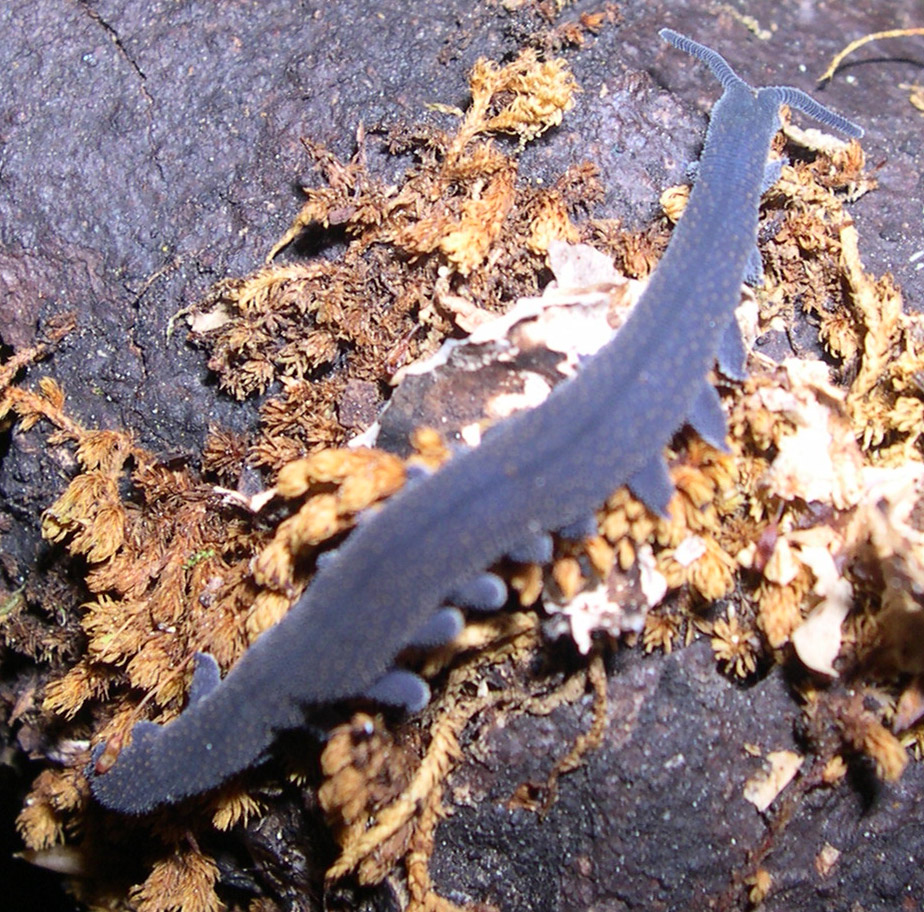
(Good further reading for this is Horseshoe Crabs and Velvet Worms: The Story of the Animals and Plants that Time has Left Behind (2012) by Richard Fortey. It’s a solid read.)
Thank you for subscribing to invertebrate facts! Did you know that the telson (tail) of the horseshoe crab contains an array of photoreceptors?
- 3 days
marine arthropod with a shell and about 10 legs looks close enough
This is exactly why it’s a meme
- fartographer@lemmy.worldEnglish4 days
Placed it in a pond… London better get ready for invasive pond crabs.
- mcv@lemmy.zipEnglish4 days
More organisms have turned into trees than into crabs.
I wouldn’t mind seeing more trains, though.
- Wirlocke@lemmy.blahaj.zoneEnglish4 days
So the absolute peak specimen would be the fusion of a tree, a crab, and a train.
- BillyClark@piefed.socialEnglish4 days
I remember some science fiction author, probably Asimov, invented a cool version of a train. Basically, next to the train is a series of moving walkways that progressively get slower as they get away from the train. So, the train never stops and people just get on or off wherever they can.
I imagine this style of train would have all sorts of problems, like people guessing wrong about when to start getting off, and ending up in the next town. Or how wherever a popular destination exists, there would be a constant mosh pit of people trying to push their way off.
- 4 days
It’s not even science fiction, they actually tried that back in the day.
https://en.wikipedia.org/wiki/Rue_de_l’Avenir
Moving walkways were initially conceived as a true form of public transit.
- topherclay@lemmy.worldEnglish4 days
That’s funny that the video on that page (last under the gallery section) has two hooligan kids standing in front of the screen just happy to be blocking the view for the novelty of being recorded on video.
They got away with it because I’m still seeing them over a hundred years later.
- destructdisc@lemmy.worldEnglish4 days
Basically, next to the train is a series of moving walkways that progressively get slower as they get away from the train. So, the train never stops and people just get on or off wherever they can.
so…a bunch of (open) trains running in parallel?
- BillyClark@piefed.socialEnglish4 days
I originally viewed it as a series of moving walkways where the center one had seats. I guess that’s why I thought of it here, since I realized it was a novel type of train.
- HessiaNerd@lemmy.worldEnglish4 days
yup, Asimov. The Caves of Steel
https://en.wikipedia.org/wiki/The_Caves_of_Steel
you can see an artist rednition in the wiki article.
- captainlezbian@lemmy.worldEnglish4 days
I forgot about the walkways. The underground megopolises however never left my mind since I read those books as a kid
- Noggog@programming.devEnglish4 days
Heinlein had it. Havent gotten to asimov yet but on my shortlist!